

Understanding Florida’s New Stormwater Regulations: What It Means for Development on Florida’s West Coast

By Ed Rogers, P.E., President, and David Fleeman, P.E., Vice President & Director of Engineering • December 3, 2025

A New Chapter in Florida’s Approach to Stormwater Management

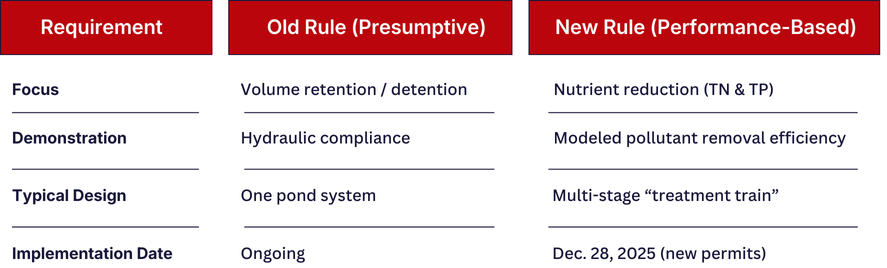
For nearly 40 years, stormwater management in Florida has followed the same fundamental approach: design systems that capture and slowly percolate or release runoff to mimic natural hydrology. Under these old “presumptive criteria,” if engineers demonstrated that a site held and discharged a certain volume of water within a specific timeframe, the design was considered compliant.


That’s changing.


The Florida Department of Environmental Protection’s (FDEP) new Stormwater management Rule SB 7040, effective June 28, 2024, with full nutrient-reduction compliance required by December 28, 2025; ushers in the most significant shift in stormwater regulation since the Environmental Resource Permit (ERP) program was created in the 1990s.


Now, compliance isn’t about detention time and volume alone, it’s about demonstrating pollutant removal performance.


Why the Regulation Was Created


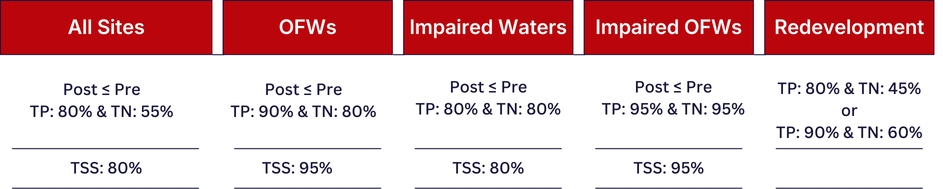
The new rule stems from the Clean Waterways Act (2020), passed by the Florida Legislation (Chapter 2020-150 F.A.C.) to reduce nutrient pollution, particularly nitrogen and phosphorus, contribute to red tide, algal blooms, and degraded spring systems. Under the old standard, systems were presumed effective if they met volume criteria. Under the new rule, engineers must quantify reductions in total nitrogen (TN) and total phosphorus (TP).


The new system requires:
  • Model-based computation of pollutant reduction.
  • Financial capability certifications for operation and maintenance entities.
From “Presumptive” to “Performance”: What’s Different

How It Impacts Developers and Engineers

For engineers and land developers, this change means larger, more complex, and costlier systems, and a fundamental shift in design philosophy.


“Under the new criteria, we’re not simply verifying the hydraulics, we’re using the revised analysis approach to model the anticipated pollutant-reduction performance of the system.” explains David Fleeman. “That changes everything from pond sizing to site grading.”


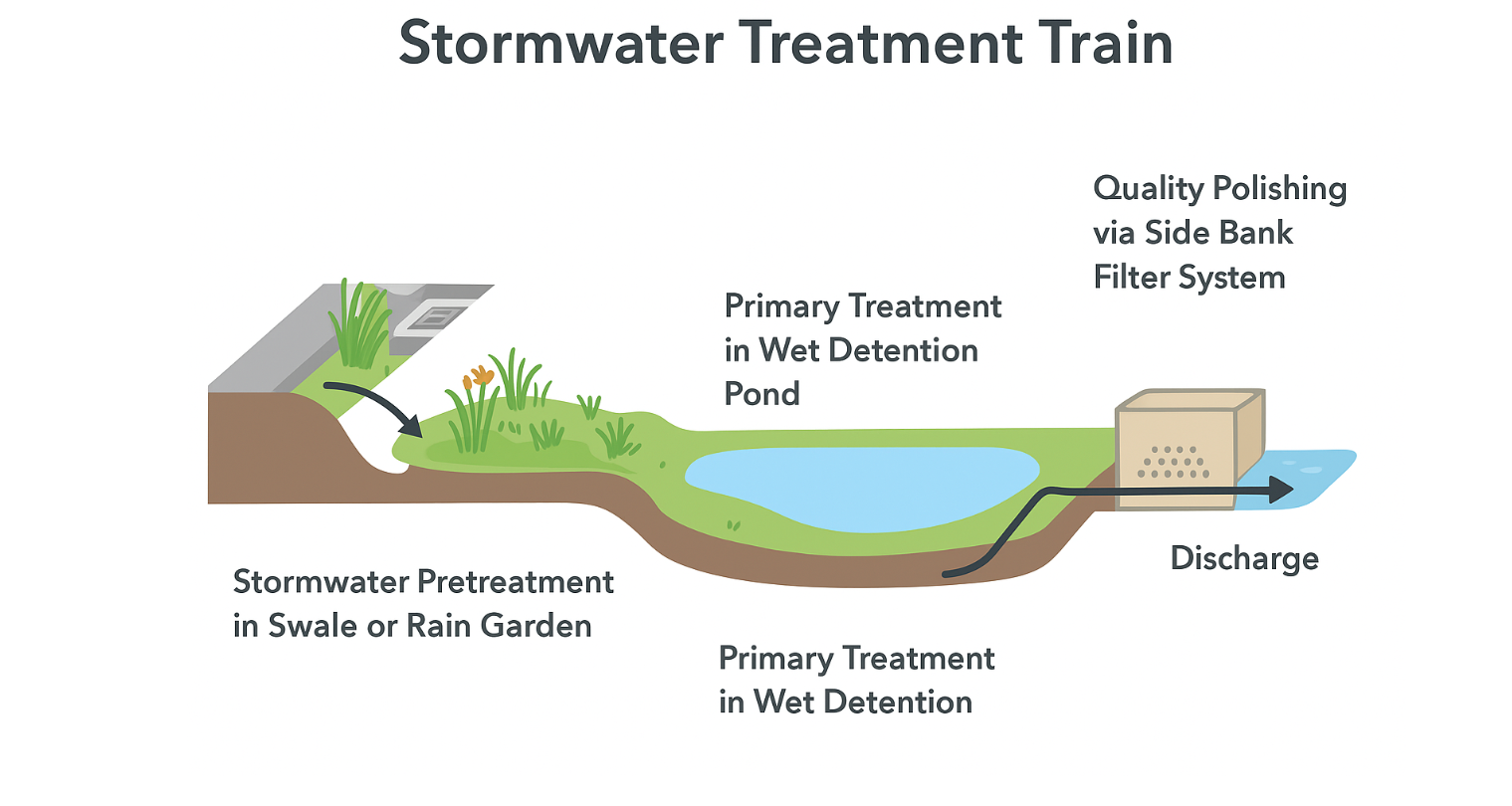
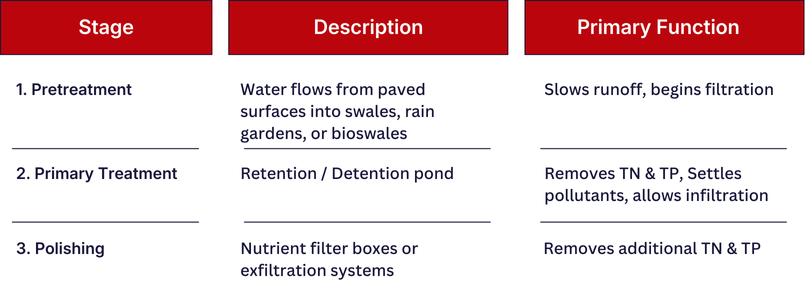
Designs that once relied on a single wet-detention pond will now likely require a multi-stage treatment train to achieve water quality standards. Stormwater runoff may be required to first flow through vegetated swales or bioretention areas, then into ponds, and finally through filtration media before leaving the site. Each stage removes a fraction of nutrients, cumulatively achieving the reduction required for compliance.

The Stormwater “Treatment Train”

Each stage removes a portion of nutrients — cumulatively achieving total statutorily required pollutant reduction.

As David Fleeman notes, “For decades, conventional commercial development has relied on extensive Directly Connected Impervious Areas (DCIA) that conveyed runoff directly to a single wet detention basin. The new criteria now require reductions in DCIA and the introduction of multi-stage treatment systems to achieve nutrient-reduction goals. These changes are reshaping industry practices, influencing site planning and greenspace design, and adding new considerations for long-term operation andmaintenance.”

The Bottom Line for Builders and Developers

Compliance isn’t optional — permits won’t be issued without modeled demonstration of nutrient reduction.

The cost implications and design complexity mean planning ahead is essential.


Top considerations for builders and developers:

  • In many instances, compliance with the rule will require more than simply a larger pond. The use of greenspace for pre-treatment will need to become a regular consideration during concept planning.
  • Allow more time for nutrient modeling and agency coordination
  • Budget land for multiple treatment stages
  • Budget for long-term and intensive & requirements and for retaining a qualified firm to conduct regular performance inspections
  • Evaluate project timing (ERP approvals issued after Dec. 28, 2025, must meet new standards)


Yet, the regulation also creates opportunities for smarter, more sustainable designs that protect Florida’s waterways for the next generation.


“The real takeaway is that this isn’t just an environmental rule, it’s a design transformation,”

says Ed Rogers “Engineers must rethink everything from how we move water to how we prove its quality.”


How FDC Is Already Managing to the New Standards

At Florida Design Consultants, our team is already designing projects under the new criteria, integrating nutrient modeling, treatment trains, and long-term & planning into our workflow.


“We’ve moved early to help our clients adapt before the deadline,” says David Fleeman. “Our designs already address these standards which will allow projects to move smoothly through permitting and

avoid costly redesigns.”

Why Partner with FDC

  • Proven Expertise – 30 years of Florida-specific engineering experience navigating SWFWMD, FDEP, and local codes.
  • Comprehensive Approach – Integrated Civil Engineering, Surveying, and Land Planning to align with the new stormwater performance framework.
  • Adaptive Design Solutions – Innovative treatment trains that achieve nutrient reduction targets while maintaining the project’s fundamental purpose and functionality.
  • Client-Centered Service – From concept through certification, FDC manages expectations, costs, and compliance every step of the way.

Learn more about our civil engineering, surveying, and planning services to see how FDC can help you navigate Florida’s evolving regulatory environment.

Share Online

A car wash and storefronts line a street under a clear blue sky.
November 7, 2025
Florida Design Consultants partnered with Promenade Retail and Pasco County to create a walkable commercial center that enhances community growth.
Blueprint with a pen; logo of Florida Design Consultants.
By Ed Rogers & David Fleeman, Florida Design Consultants September 10, 2025
Discover how accurate pre-construction preparation helps developers and builders avoid costly mistakes. FDC experts Ed Rogers and David Fleeman share insights on risk reduction, planning, and technology.
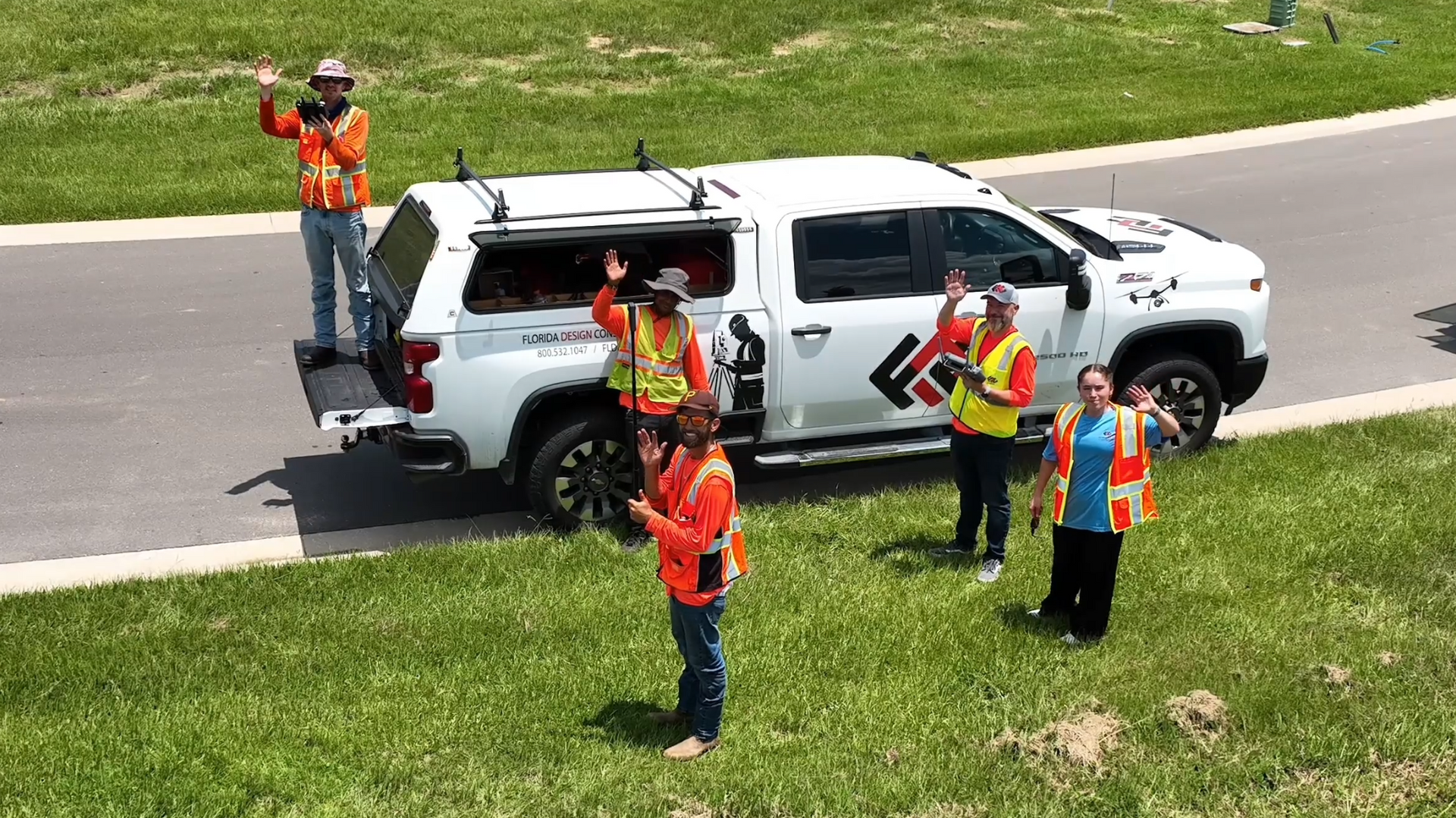
Group of people in safety vests near a white pickup truck on a grassy area, waving at the camera.
By Jared Patenaude and Brian Drinkwater August 6, 2025
“We’ve seen situations where traditional fieldwork might take two weeks. Drones can capture the same data in hours, without sacrificing accuracy.”
A group of civil engineers  are looking at a map in front of a truck.
By Rob Rosner July 18, 2025
Discover how Florida Design Consultants blends aesthetics and function in modern landscape design to create sustainable, beautiful, and functional spaces.
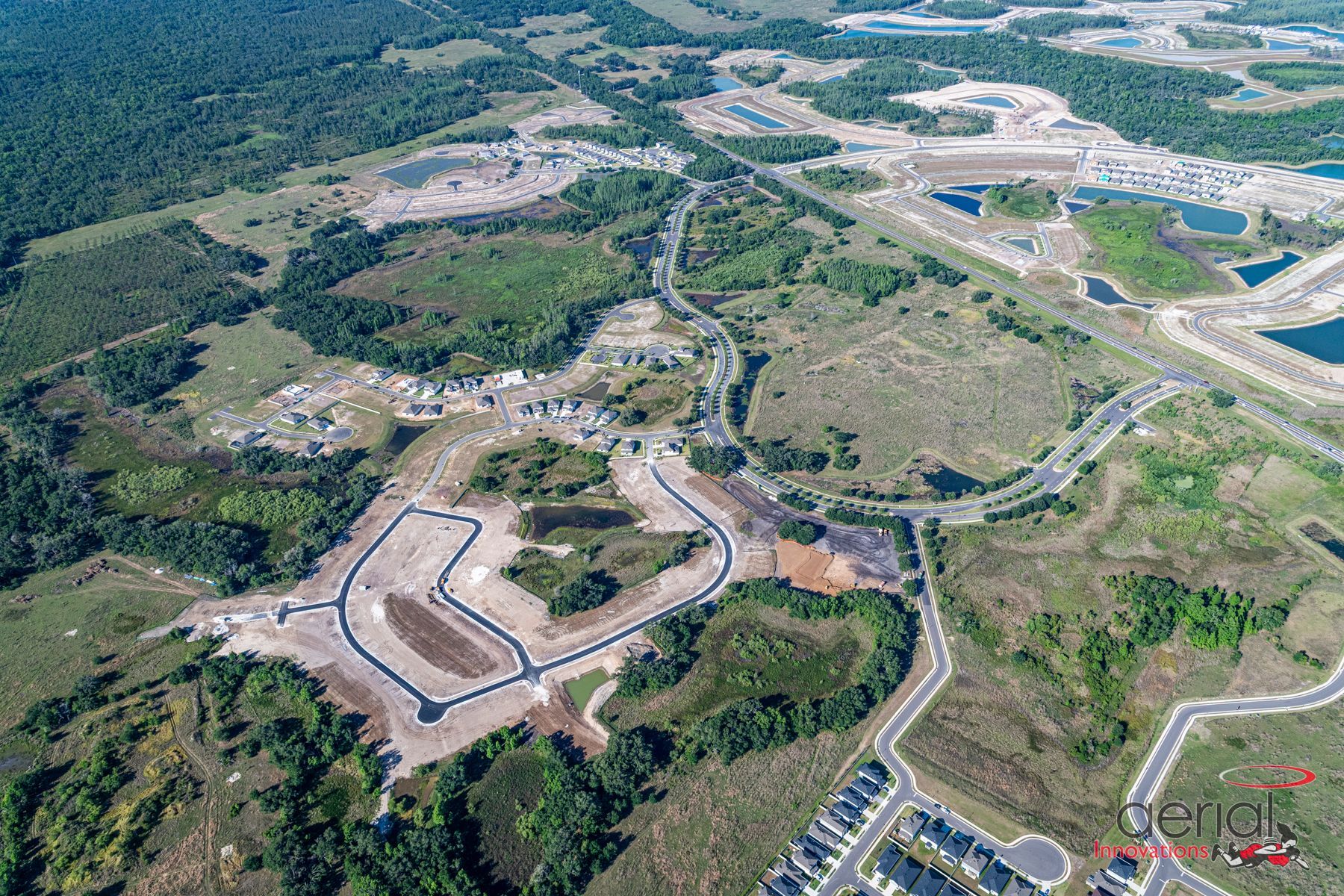
An aerial view of a construction site with a lot of trees and roads.
May 13, 2025
Discover how Florida Design Consultants helped Pulte revitalize Riverwood, overcoming infrastructure, permitting, and environmental challenges to accelerate time-to-market.

A group of people are standing around talking to each other at a community event sponsored by Florida Design Consultants
March 27, 2025
Florida Design Consultants Sponsors Pasco EDC’s 22nd Annual NetFest to Support Economic Development and Community Growth
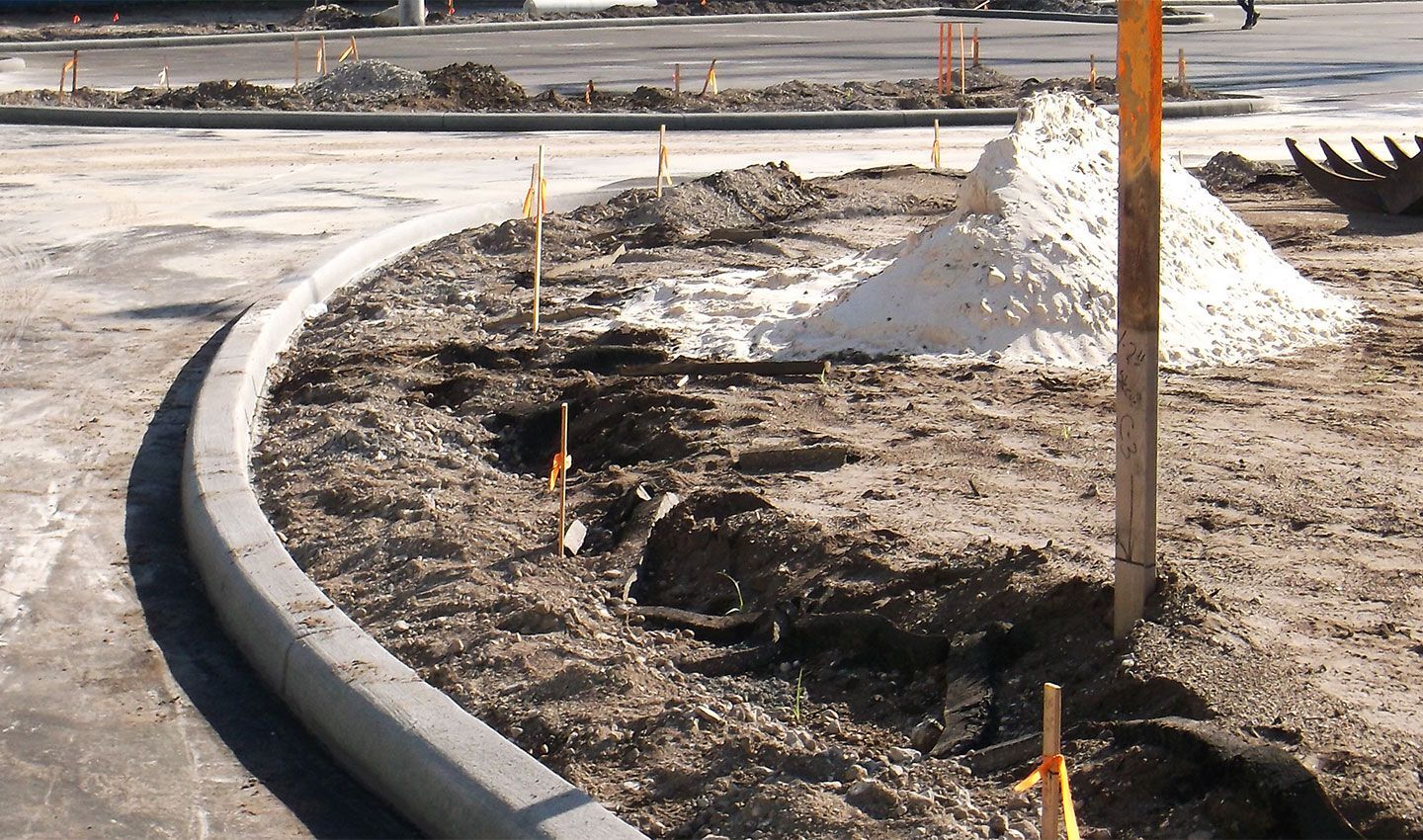
A construction site with a pile of dirt in the middle with stakes around it.
January 18, 2025
Florida Design Consultants, Inc.'s Survey Department has been a trusted partner for municipal, private land development, and site contractor clients for over 20 years. Specializing in construction stakeout and record (as-built) surveys, the department supports diverse projects ranging from residential and commercial developments to major roadway and pipeline initiatives. With a team-oriented approach and a commitment to meeting schedules and budgets, the department prides itself on its repeat business and ability to resolve construction challenges effectively.
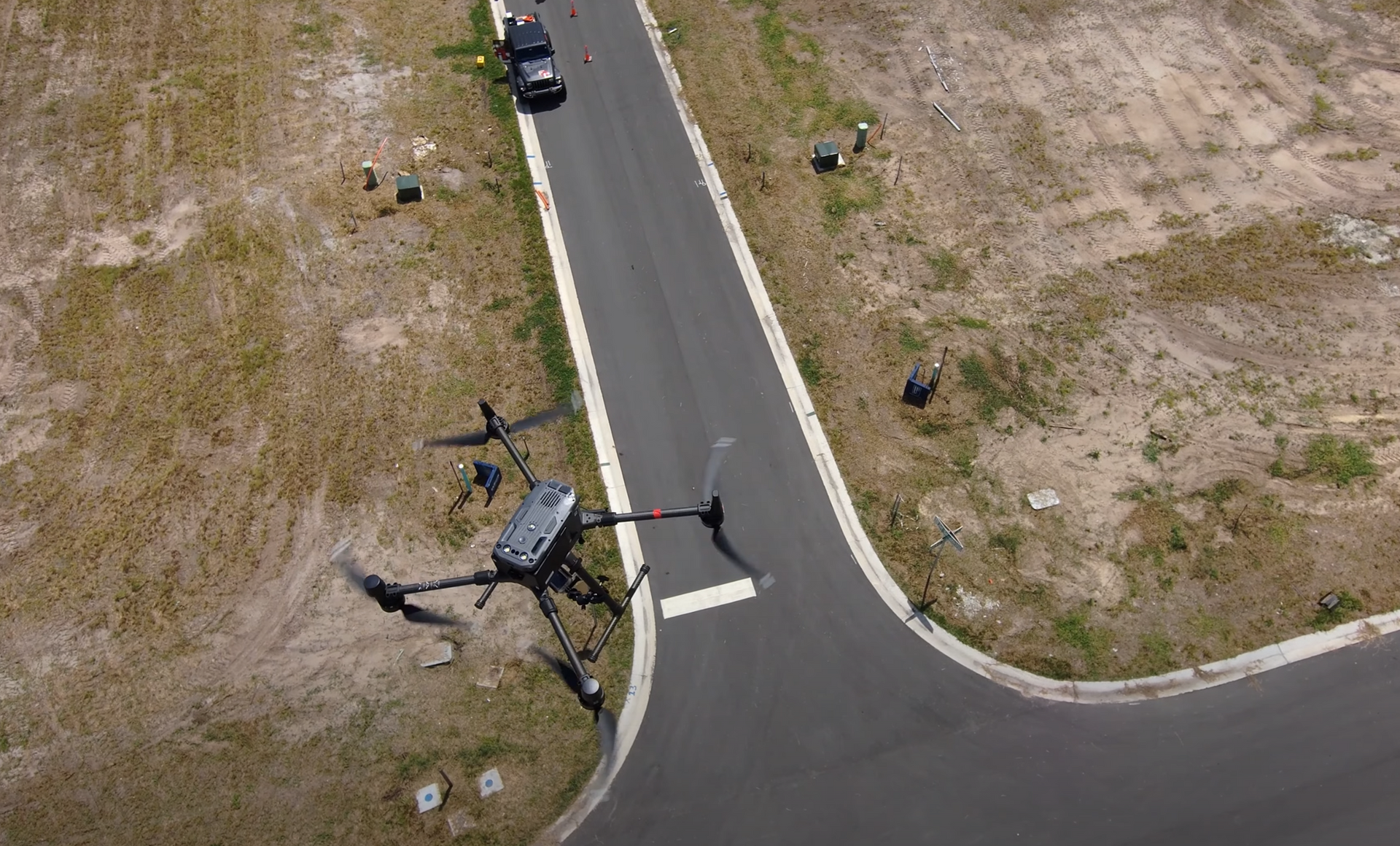
An aerial view of a drone flying over a road.
By Jared Patenaude October 10, 2024
Addressing Industry Challenges with Advanced 3D Terrain Modeling Solutions The construction and land development industries are undergoing significant transformation. The rise of new technologies like 3D modeling, drones, and LiDAR is reshaping how land developers, contractors, and home builders manage projects. However, despite these advancements, the industry continues to face familiar challenges: project delays, cost overruns, and disputes over site conditions. As we move forward, innovative solutions must be embraced to stay competitive. In this blog, we’ll explore the latest trends in construction technology, the ongoing challenges the industry faces, and how advanced solutions like 3D terrain modeling can provide answers. Industry Trends: The Push for Data-Driven Construction With increasing pressure to reduce costs, improve efficiency, and maintain transparency, companies in construction, land development, and home building are looking toward data-driven technologies to meet these demands. According to a McKinsey report, early adopters of digital tools like 3D modeling, drones, and real-time data analytics have seen project costs drop by up to 15%. This shift towards technology not only optimizes workflows but also minimizes risks. Key technological trends shaping the future of construction include: Drones and Aerial Data Capture: Drones are an essential tool for tracking project progress, conducting site inspections, and capturing aerial images. These devices allow for faster data collection, reducing the need for on-site inspections, and providing developers, contractors, and builders with near real-time insights into site conditions. 3D Modeling and Photogrammetry: By creating detailed 3D models of development and construction sites, companies can better visualize project stages, identify potential issues early, and ensure alignment between all stakeholders – whether developers, contractors, or end-users. Photogrammetry —creating 3D images from aerial photographs—is widely used for progress tracking, but often lacks the precision needed for critical tasks like volume calculations and topography assessments. LiDAR Technology: LiDAR (Light Detection and Ranging) offers far greater precision than photogrammetry. By using lasers to measure distances, LiDAR produces accurate, survey-grade models of construction sites, allowing for better project management and dispute resolution. Challenges That Persist in Land Development and Construction Despite technological advances, both the construction and land development industries continue to struggle with several recurring challenges: 1. Inaccurate Progress Tracking: Traditional aerial snapshots taken periodically throughout a project often fail to provide the level of detail needed for accurate tracking, leading to disputes between contractors and developers over project progress. 2. Costly Disputes: Damage to utilities, site conditions, or construction errors can result in significant delays and additional costs. Without accurate records of the site's condition at each stage, developers and contractors face difficulties resolving these disputes. 3. Project Delays and Miscommunications: Managing large-scale construction projects requires constant communication between all stakeholders. However, outdated data and inconsistent site inspections often lead to miscommunication, slowing down project timelines and increasing costs for all parties involved.